Featured
A phishing page interested in MX records, (Tue, Nov 17th)
SANS Internet Storm Center, InfoCON: greenNov 17, 2026
A phishing page interested in MX records, (Tue, Nov 17th)

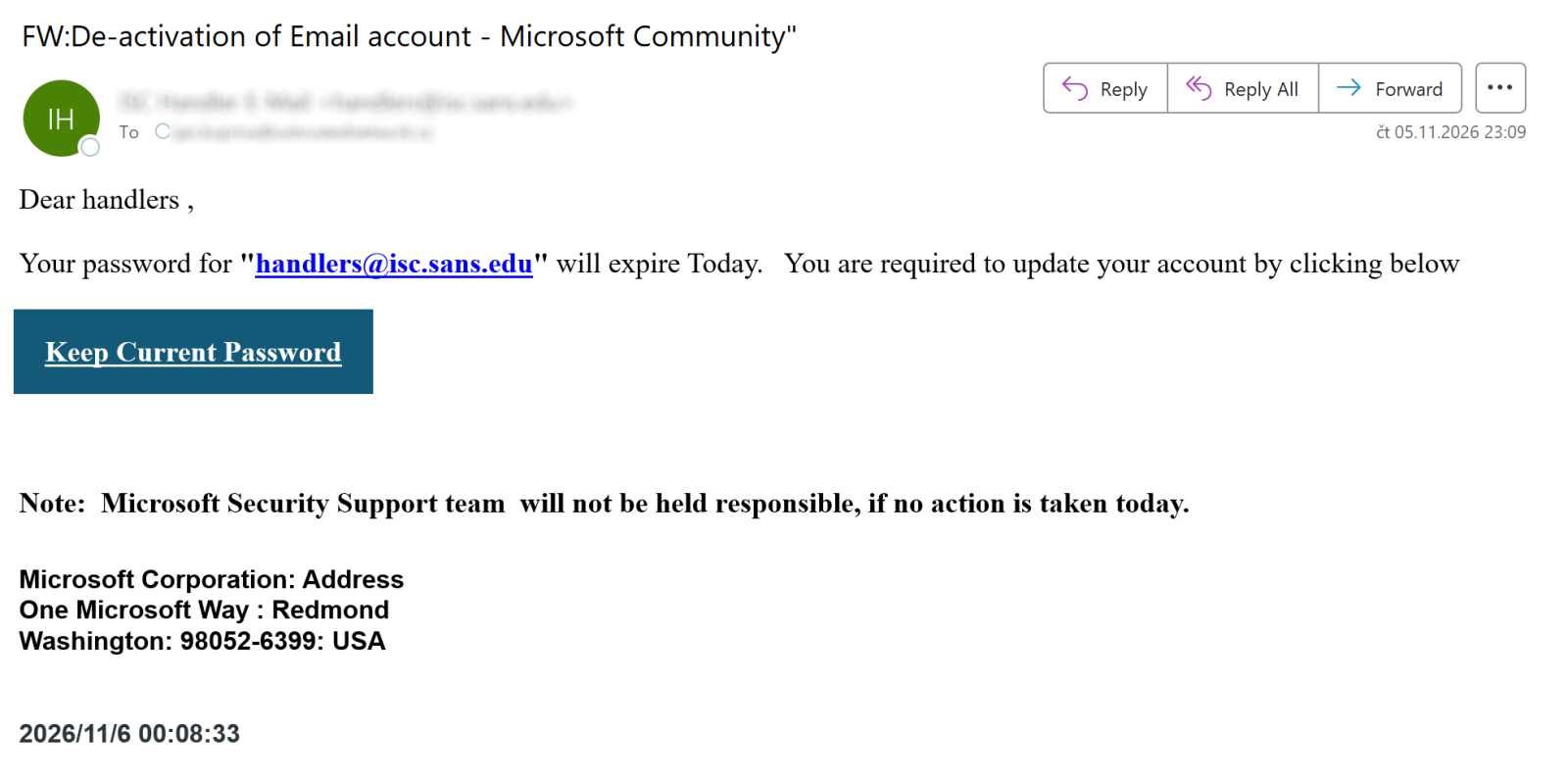
I&#;x26;#;xe2;&#;x26;#;x80;&#;x26;#;x99;ve mentioned before in some of my diaries that it can be instructive to look at what appear to be &#;x26;#;xe2;&#;x26;#;x80;&#;x26;#;x9c;generic&#;x26;#;xe2;&#;x26;#;x80;&#;x26;#;x9d; phishing messages in detail from time to time, since some of them might prove not to be as generic as they initially appear. I came across a good example of this while going over phishing messages delivered to our handler inbox over the past few weeks, when a message that, at first glance, appeared to be a fairly ordinary attempt at stealing e-mail credentials turned out to lead to a page interested in collecting a little more information than just the victim&#;x26;#;39;s password.

LatestView all latest →
Hackers Found a Way Around GitHub SHA Pinning. This Webinar Explains How to Close the GapThe Hacker News
Hackers Found a Way Around GitHub SHA Pinning. This Webinar Explains How to Close the Gap

Pinning GitHub Actions to an exact version of their code, known as SHA pinning, has become the go-to defense against software supply chain attacks. Attackers have already found a way around it. In March 2026, the hackers who hijacked Trivy, a widely used open-source security scanner, planted malicious code that looked like it came from GitHub's official checkout tool. They even labeled it a

Nov 17, 2026
Researchers Detail iPhone Flaw That Let Apps Record Audio Despite Denied Microphone PermissionThe Hacker News
Researchers Detail iPhone Flaw That Let Apps Record Audio Despite Denied Microphone Permission

A now-patched flaw in Apple's audio service let apps on iPhones and iPads record audio even after the user tapped "Don't Allow" on the microphone prompt. The first security updates with the fix came out on August 17. Neither Apple nor the two researchers who found the flaw report that it was used in attacks. Nik Tsytsarkin of Meta Red Team X published the technical details last week. Mustafa

Nov 17, 2026
European Commission Plan to Give Frontex Trusted Flagger Status Is A Threat to Free SpeechDeeplinks
European Commission Plan to Give Frontex Trusted Flagger Status Is A Threat to Free Speech

EFF and 27 other human rights organizations called on the European Commission today to retract a dangerous proposal granting its border agency Frontex to request that national authorities issue takedown orders for social media content and giving it “trusted flagger” status under the Digital Services Act (DSA), the EU regulation governing online platforms and content moderation in the region. The extraordinarily improper proposal not only disregards the provisions of the DSA but also places a mechanism of enforcement overreach in the hands of a law enforcement agency that has failed to safeguard people against serious human rights violations at EU borders. Under the proposal , Frontex has the power to “monitor publicly accessible social media content, detect developments relevant to external border management, and support action against illegal online content linked to border-security risks.” Granting Frontex trusted flagger privileges on top of its existing mandate risks creating a powerful mechanism for over-enforcement, stifling the free expression of migrants, asylum seekers, and other marginalized groups. We warned the Commission of these risks in a letter . The DSA is supposed to make online platforms more accountable and protect users’ fundamental rights, not give the EU power to sic its border police on people for exercising their right to free expression. EFF and other rights organizations have for years sounded alarms about potential abuse under the DSA’s trusted flagger provision, which gives “Digital Services Coordinators” the ability to award entities—including law enforcement agencies—a privileged channel to alert online platforms about illegal content. We’ve taken the firm position that law enforcement cannot be trusted to properly flag illegal content. In July, we told the Commission that giving law enforcement trusted flagger status could undermine fundamental rights and said that police agencies like Frontex should not be made trusted flaggers. The EU proposal gives Frontex decision-making power over free expression that is not envisaged under the DSA. First, content removal orders can only be issued by relevant national authorities. The DSA does not foresee a role for entities like Frontex to request such orders. Second, trusted flaggers notify platforms of suspected illegal content—platforms must prioritize these notices and they have sole responsibility to decide to remove content. It’s not flaggers’ role to request removal orders from national authorities. Combining these powers blur enforcement and flagging functions, which the Commission’s own draft guidelines on trusted flaggers explicitly caution against. “The risk of Frontex utilizing its power as both a Trusted Flagger and authority that can demand removal orders, to surveil user-generated speech, and over-flag content under the guise of ‘border security risk’ is clear. This will likely result in platforms over-censoring content and chilling the speech of already marginalized groups, particularly those from migrant and asylum-seeking communities,” the letter says. We urge the Commission to rescind the proposal. It undermines the DSA, threatens fundamental rights of citizens and non-citizens, and is enforcement overreach that does not align with international human rights standards.

Nov 17, 2026
New GitDoor and GraphDoor Backdoors Turn GitHub and SharePoint Into Covert C2 ChannelsThe Hacker News
New GitDoor and GraphDoor Backdoors Turn GitHub and SharePoint Into Covert C2 Channels

Government sectors in Asia and Africa have been targeted by an active cyber intrusion campaign that delivers to previously undocumented backdoors that leverage legitimate services like Microsoft SharePoint and GitHub for command‑and‑control (C2). The activity has been codenamed Operation ShadowCloud by Kaspersky. The Russian cybersecurity company said it identified the campaign in early 2026.

Nov 17, 2026
Apple Tightens macOS App Permissions to Limit Data Access Amid AI Agent Security RisksThe Hacker News
Apple Tightens macOS App Permissions to Limit Data Access Amid AI Agent Security Risks

Apple on Monday introduced new controls that allow Mac users to give more granular access to data they give to apps, including those that use artificial intelligence (AI) agents. The changes, currently previewed in macOS 27.3 beta 2, relate to increased transparency and more options for two of its APIs: Device Control and Data Access, and Full Disk Access. "Before granting an app such

Nov 17, 2026
A phishing page interested in MX records, (Tue, Nov 17th)SANS Internet Storm Center, InfoCON: green
A phishing page interested in MX records, (Tue, Nov 17th)

I&#;x26;#;xe2;&#;x26;#;x80;&#;x26;#;x99;ve mentioned before in some of my diaries that it can be instructive to look at what appear to be &#;x26;#;xe2;&#;x26;#;x80;&#;x26;#;x9c;generic&#;x26;#;xe2;&#;x26;#;x80;&#;x26;#;x9d; phishing messages in detail from time to time, since some of them might prove not to be as generic as they initially appear. I came across a good example of this while going over phishing messages delivered to our handler inbox over the past few weeks, when a message that, at first glance, appeared to be a fairly ordinary attempt at stealing e-mail credentials turned out to lead to a page interested in collecting a little more information than just the victim&#;x26;#;39;s password.

Nov 17, 2026

Get the week in AI, in one email

The stories that mattered most from 90+ AI sources, every Monday. No spam, unsubscribe anytime.